
Chianti wine making: land, time and identity
Talking about Chianti wine making means entering a world shaped by patience, land, careful choices, and respect for a tradition that in Tuscany is never only technical, but also deeply cultural. When people enjoy a glass of wine, they often notice its aroma, color, balance, and pleasure. Yet behind that result there is a much longer journey, one that begins among the vines, through seasons and skilled hands, and only later reaches the moment of tasting.
This is exactly what makes wine so fascinating: how does a Chianti truly come to life, and what makes one bottle more memorable than another? To answer that, you need to start from the land, the landscape, and the people who follow the wine every day, from vineyard to bottle.
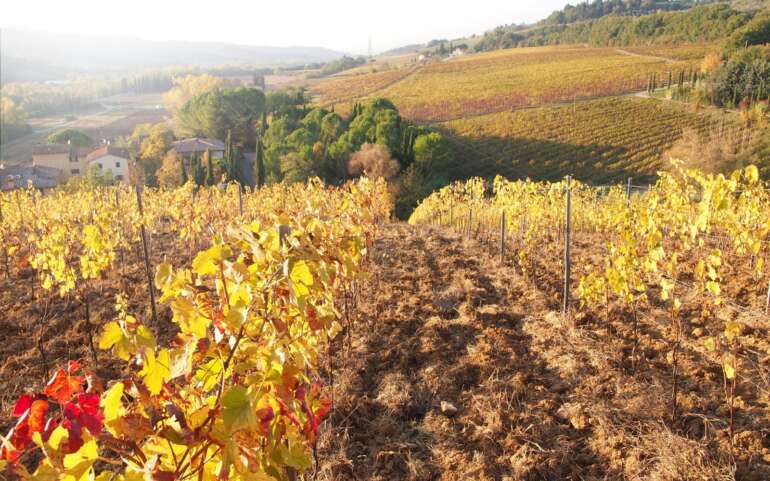
In the case of Tenuta Le Lame, the connection with the territory is clear from the very beginning. The estate is located in San Casciano in Val di Pesa, on the hills surrounding the Pesa river, west of Florence, and it has long been linked to the Zanobini family, who have dedicated themselves to wine production for generations with attention to tradition and a constant focus on quality.
The land matters more than many people think
Even before the cellar, it is the land that shapes the character of the wine. In the case of Chianti Classico, Sangiovese is the main grape variety and the true protagonist of one of Tuscany’s most recognizable wine expressions. This is not just a technical detail for specialists. It is one of the reasons why Chianti has maintained such a strong and respected identity around the world.
Chianti is not simply one of the most famous Italian wines. It is a true global excellence and one of Tuscany’s strongest wine symbols. Even abroad, the name immediately evokes vineyards, hills, tradition, and a culture of wine that is deeply rooted in place.
From the vineyard to the harvest: the first great selection
The quality of a wine is built long before vinification begins. Every vintage depends on climate, exposure, vineyard altitude, and the balance between ripeness, acidity, and aromatic concentration. Harvest time is therefore one of the most delicate phases: it is not enough to pick the grapes, they must be picked at the right moment.
This is where true sensitivity in the vineyard becomes essential. A careful harvest lays the foundation for a wine that can express balance, personality, and longevity. It is at this stage that Chianti wine making starts to take real shape, because final quality always begins with grapes selected with attention and experience.
Chianti wine making between technique and sensitivity
The cellar is often the phase that fascinates wine lovers the most. Once the grapes are harvested, they are handled with care to preserve their purity, structure, and expressive potential. Fermentation, maceration, temperature control, and ageing are not automatic steps. They are decisions that guide the final profile of the wine.
When a producer truly knows the land, the goal is not to artificially construct a wine, but to translate into the bottle what the vineyard has expressed in that specific vintage. This is where technique meets experience: method matters, but so do sensitivity, coherence, and the ability to read the land without distorting it.
This is also why wines linked to a reality such as Tenuta Le Lame can spark real curiosity. Behind them there is not just a bottle, but continuity between land, family, and identity. The wine is not accidental. It is the result of a precise path.
Why Chianti continues to fascinate the world
Many people approach Chianti because of its fame, but they continue to choose it because of its personality. There is something deeply recognizable about this wine: its connection to Tuscany, its balance of freshness and structure, and its ability to accompany food while also expressing a territory with clarity.
For this reason, Chianti remains one of the strongest names in Italian viticulture. It is not just a famous wine; it is an entry point into a wider culture that brings together agricultural work, tradition, landscape, and taste. When that story is connected to a family estate, it becomes even richer and more compelling.
Tenuta Le Lame: a story that makes the wine even more interesting
One of the aspects that most intrigues readers is understanding that behind a wine there is not only a label, but a real story. Tenuta Le Lame represents this idea perfectly: a production rooted in the Chianti hills, close to Florence, and closely linked to the Zanobini family.
This makes the wine even more interesting, because it is not an anonymous product, but a living expression of the territory. And it is exactly this direct connection between estate, tradition, and bottle that turns simple curiosity into the desire to discover more.
From the estate to the wine shop: wine is truly understood when tasted in the right place
So far we have spoken about vineyards, harvest, cellar work, and territory. But wine, to be fully understood, also needs the right moment and the right place to be tasted. This is where the whole story finds its natural completion.
For those who want to approach this story not only by reading about it, but also by tasting it, the ideal destination is Enoteca F.lli Zanobini in the heart of Florence. Here, the wine from the estate is not just a bottle on display, but the concrete continuation of a family story that begins in the hills of San Casciano in Val di Pesa and reaches the city center.
Visitors can also discover more about the connection between bottle, tasting, and territory by exploring the world of Tenuta Le Lame wines and experiencing wine not as an abstract concept, but as something real and authentic.
This is perhaps the detail that creates the greatest curiosity: knowing that behind a glass tasted in Florence there is a real estate, careful production, and a tradition that continues to evolve without losing its identity. In this sense, Chianti wine making stops being only an interesting topic and becomes something to be experienced for real.