
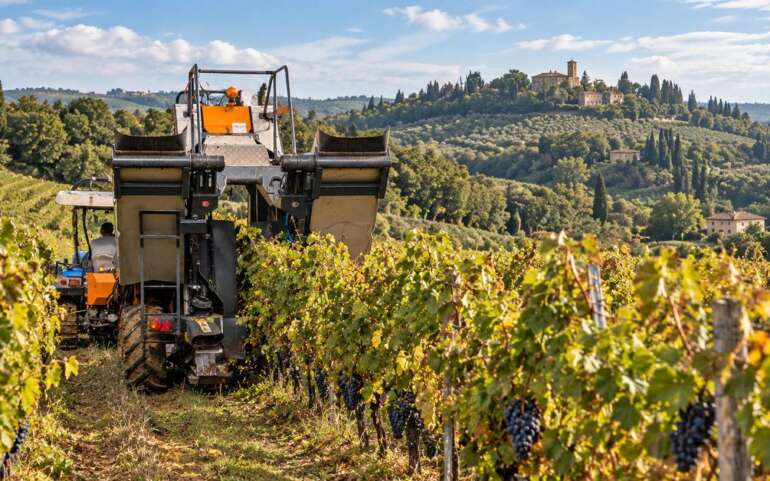
Chianti Classico Harvest 2026: an exceptionally hot summer, an early harvest and a result that could become part of the recent history of Tenuta Le Lame. According to the estate’s initial assessments, this year’s harvest could rank among its finest of the past ten years.
This was far from a predictable outcome. The high temperatures required constant attention and carefully planned vineyard management to protect the grapes and preserve their balance. Yet it was precisely during this challenging season that the value of the work carried out in the vineyards of Tenuta Le Lame, an estate historically connected to the Zanobini family, became clear.
To understand why the 2026 vintage looks so promising, we need to go back a few months, when the weather seemed to be telling a very different story.
A hot summer, but with a valuable resource
Heat was one of the defining features of the 2026 growing season. Exceptionally high temperatures could have affected the balance of the grapes, increasing water stress in the vines and making the ripening process more difficult to manage.
However, the abundant rainfall recorded between late winter and early spring made an important difference.
Those rains allowed the soil to build up significant water reserves, which proved particularly valuable during the summer months. The vines were therefore able to withstand the highest temperatures thanks to the available moisture, limiting the effects of drought and heat stress.
This is one of the most interesting aspects of the vintage: the quality of a harvest does not depend only on the weather during picking, but on the conditions throughout the entire growing season.
Protecting the grapes and choosing the right moment
Favourable conditions during the preceding months were not enough, on their own, to guarantee success. Throughout the summer, vineyard management required specific measures to protect the grape clusters from excessive exposure to sunlight.
The most significant decision came at harvest time.
At Tenuta Le Lame, the decision was made to bring the harvest forward by a few days to limit the effects of further sun exposure and preserve grape quality.
This was an important choice, because identifying the right moment to pick means finding the balance between ripeness, concentration and the characteristics that the future wine will be able to express.
The harvest is therefore not simply the final stage of work in the vineyard: it is also the moment when many of the decisions made throughout the year reveal their true significance.
Healthy grapes and excellent results
The estate’s initial assessments describe the 2026 harvest as excellent in quality, with healthy grapes and high sugar concentration.
The latter is particularly interesting from an oenological perspective, as the sugar content of grapes contributes to determining the potential alcohol level of the wine through fermentation.
For the wines produced from the 2026 harvest, the estate expects an average alcohol content of approximately 14.5% ABV. This is, of course, an initial estimate rather than a definitive figure for individual wines.
What emerges most clearly is the quality of the raw material: an essential starting point for the subsequent work in the winery.
The 2026 rosé promises character
Among the first oenological indications, the rosé deserves particular attention.
Initial assessments suggest a wine with a distinctive character, pronounced flavour and a generous structure, accompanied by a pleasant softness on the palate.
This is an interesting profile, suggesting a rosé with a recognisable personality, capable of expressing intensity without losing its appeal.
Of course, winemaking and the wine’s subsequent evolution will determine whether these expectations are confirmed. For now, the estate’s report highlights particularly encouraging quality potential.
Red wines: structure and finesse
The outlook is especially positive for the red wines as well.
Early impressions suggest wines that are aromatic, full of flavour and endowed with significant structure, together with excellent finesse on the palate.
It is precisely this balance between richness and finesse that makes the vintage so interesting. Good structure is an important characteristic, but the ability to combine it with elegance and harmony is what helps define a wine’s personality.
According to the estate’s report, the quality of the harvested grapes offers promising prospects across the entire range: from the traditional yellow-label Chianti Classico to the two Gran Selezione wines.
Among the most representative expressions of the family’s production is Sorripa Gran Selezione, to which we have dedicated an article exploring its history, characteristics and connection with the territory.
However, to understand the final profile of the future 2026 wines, we will have to wait until their respective production and ageing processes have been completed.
One of the best vintages of the past decade?
This is probably the most significant assessment to emerge from the 2026 harvest report.
According to the initial evaluations carried out by Tenuta Le Lame, the 2026 vintage could rank among the estate’s finest of the last ten years.
This is not yet a definitive judgement on the finished wines, but an assessment based on grape quality and the first oenological indications.
The summer heat, the water reserves accumulated during the preceding months, the protection of the grape clusters and the decision to harvest early all contributed to the result.
Confirmation will come with time, as the wines complete their development. This anticipation is part of what makes the work of winegrowers and oenologists so fascinating: an outstanding harvest creates the conditions for outstanding wine, but the journey does not end when the grapes are picked.
From Tenuta Le Lame to Enoteca Zanobini
The 2026 harvest also tells a broader story: the direct connection between wine production and those who present it to customers every day.
For the Zanobini family, this connection has a special meaning. The wines begin their journey in the vineyards of Tenuta Le Lame, in San Casciano in Val di Pesa, and symbolically continue to Enoteca Fratelli Zanobini, the historic wine shop established in central Florence in 1944.
Here, wine is not simply a bottle displayed on a shelf. It is the result of production decisions, experience and knowledge of the territory, all of which can be shared directly with customers.
The role of Marco Zanobini, the family’s oenologist, represents precisely this connection between wine production and the enoteca: understanding a wine from its origins makes it possible to tell its story with greater knowledge and authenticity.
For anyone visiting Zanobini in search of a Chianti Classico, the opportunity to understand the work behind every bottle is an integral part of the experience.
The harvest is over, but the story continues
The grapes have been harvested, but the journey of the 2026 wines has only just begun.
The initial assessments are extremely positive: healthy grapes, impressive concentration and promising prospects for both the rosé and the estate’s red wines.
Now, time and careful work in the winery will shape the final characteristics of each wine.
One thing, however, is already clear: the 2026 harvest at Tenuta Le Lame has all the makings of a particularly memorable vintage.
And at Enoteca Zanobini, we will continue to follow and share its evolution, from the vineyard to the moment when the results of this harvest can finally be appreciated in the glass.