
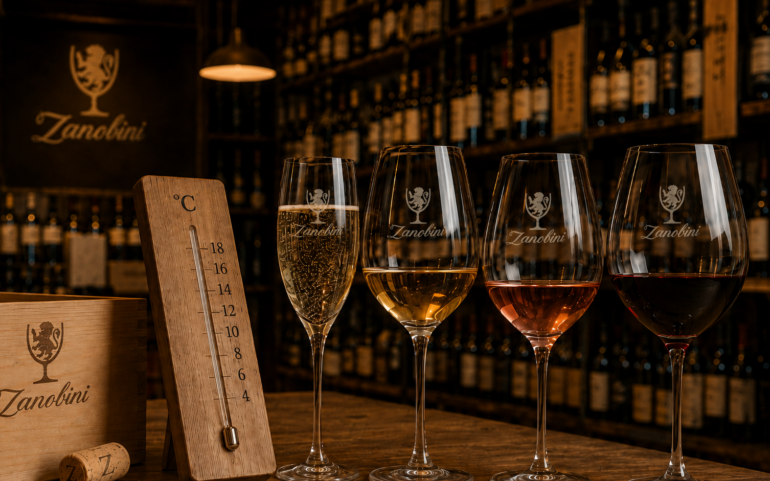
Wine temperature is a technical detail that is often underestimated, but it can completely change the experience in the glass. The same wine, served too warm or too cold, may seem more alcoholic, harsher, less aromatic or less balanced.
When people talk about wine, they often think of the grape variety, the production area, the vintage, the producer or the food pairing. All of these elements are important. But before tasting, there is one practical aspect that immediately affects perception: the serving temperature.
At Enoteca Zanobini, a historic Florentine wine shop since 1944, wine is also explained through these small but important details. Serving a bottle properly does not mean making things complicated: it means allowing the wine to express itself in the most balanced way.
Wine Temperature: why it matters
Wine temperature influences three essential aspects: aromas, taste and the tactile sensation in the mouth. A wine served too cold tends to close up, reducing aromatic expression. A wine served too warm, on the other hand, can make alcohol more noticeable and disturb the balance of the sip.
This applies to every style of wine: reds, whites, rosés, sparkling wines and sweet wines. There is no single perfect temperature for every bottle, because each wine has its own structure, acidity, body, tannins and aromatic intensity.
Professional serving guidelines usually distinguish between sparkling wines, light whites, more structured whites, rosés, young reds and fuller-bodied reds. WSET, one of the best-known international wine education organisations, also explains that different wine styles require different serving temperatures, from well-chilled wines to reds served at room temperature or slightly cooled in its guide to wine serving and storage.
Red wine: not always at room temperature
One of the most common mistakes concerns red wine. Many people think it should always be served at “room temperature”. The problem is that this expression comes from contexts very different from today’s homes, restaurants and heated rooms, which can easily exceed 20 degrees Celsius.
A red wine served too warm may seem heavier, more alcoholic and less elegant. Heat makes the perception of alcohol stronger and can make the aromas less precise. In more structured red wines, the sip can also become less harmonious.
For many red wines, especially fuller-bodied or more important bottles, a temperature around 16-18°C is often more suitable than a warm room. For younger and more fragrant reds, a slight freshness can help enhance fruit, drinkability and clarity.
Chianti Classico and Tuscan red wines
This topic is especially interesting for Tuscan wines and Chianti Classico. A Tuscan red served too warm risks losing finesse and showing more alcohol than territory. Served at the right temperature, however, it can express aromas, tannins, acidity and depth more clearly.
The wines of the Zanobini family, produced by Tenuta Le Lame, such as Chianti Le Lame, Sorripa, Masso della Strega and Formazione, are good examples of this balance. They come from the Chianti Classico area and deserve to be served with attention, without excessive warmth and without aggressive chilling.
A Chianti Classico served slightly cooler than a very warm room temperature can feel more harmonious, lively and readable. The tannins remain present, but less rough; the fruit becomes clearer; the alcohol is better integrated.
White wine: chilled, but not frozen
With white wine, the opposite mistake is also common: serving it too cold. A white wine just taken from a very cold refrigerator may feel pleasant at first, but it can lose aromas and complexity.
Extreme cold tends to block aromatic expression. The wine may seem fresh, but not very communicative. For simple and immediate whites, a lower temperature can work well, especially in summer, but more structured whites usually benefit from a few extra degrees.
A white wine served at the right temperature can better show floral, fruity, mineral or more evolved notes. Freshness remains important, but it should not erase the wine’s personality.
Sparkling wines
Sparkling wines generally require lower serving temperatures than still wines. Cold helps preserve freshness, energy and precision in the bubbles. However, even here, excess should be avoided.
A sparkling wine served too warm loses vitality and may feel heavier. A sparkling wine served too cold, instead, can become neutral and less expressive. This is why it is useful to chill the bottle well, while remembering that more complex sparkling wines also need space to express aromas and structure.
For an aperitif, a fresh temperature is usually ideal. For a more important or evolved sparkling wine, a slightly higher temperature can help reveal its aromatic side.
Rosé and sweet wines
Rosé wines are often close to whites in terms of serving temperature. They should be fresh, especially when young, fruity and made for easy drinking. But even in this case, cold should not make the wine anonymous.
Sweet wines are usually served well chilled. A lower temperature helps maintain balance and prevents sweetness from becoming excessive. Freshness, acidity and aromas need to work together to make the sip pleasant rather than heavy.
Wine warms up in the glass
An important detail is that wine does not remain at the same temperature once it has been poured. In the glass, it tends to warm up quickly, especially in summer or in warm rooms.
For this reason, it can be useful to serve wine slightly cooler than the ideal final temperature. In just a few minutes, it will rise by a few degrees in the glass. This is especially true for red wines in summer and for whites enjoyed slowly.
The glass itself also affects perception. A wider glass encourages oxygenation and the diffusion of aromas, but it can also make the wine warm up more quickly. Careful service takes this into account as well.
The most common mistakes
The first mistake is serving red wines too warm. This often happens at home, in heated rooms or during the summer. The result is a wine that feels more alcoholic, less fresh and less balanced.
The second mistake is serving white wines too cold. The wine may appear clean and refreshing, but it loses aroma and depth. In more complex white wines, this can strongly penalise the tasting experience.
The third mistake is thinking that one fixed rule is enough. Every bottle has its own personality. A young red should not be treated like a very structured red; a simple sparkling wine does not require the same approach as a more important one; a light white behaves differently from a fuller-bodied or aged white.
How to serve wine at home
You do not need complicated tools. A wine thermometer can be useful, but a few simple habits are often enough.
If a red wine has been kept in a warm room, it can be useful to place it in the refrigerator for 15-20 minutes before serving. The goal is not to make it cold, but to bring it back to a more balanced temperature.
If a white wine is too cold, it can be taken out of the refrigerator a few minutes before serving. With an important bottle, a few extra degrees can make a major difference in the perception of aromas.
For sparkling wines, it is useful to keep the bottle cool during service, especially if it is enjoyed slowly. An ice bucket with water and ice is often more effective than the refrigerator alone, because it keeps the temperature more constant.
Wine temperature and wine tasting in Florence
Those looking for a historic wine shop in Florence often want more than simply buying a bottle. They also want to understand how to serve and enjoy it properly. Temperature is one of those details that can transform a correct wine into a truly pleasant one.
At Enoteca Zanobini, wine advice does not stop at choosing the label. A bottle can also be explained through the way it is served: temperature, glass, moment, pairing and occasion.
This applies to an aperitif wine, a bottle to bring to dinner, an important Tuscan red or a Chianti Classico to share. Every practical choice helps the wine express itself better.
The right wine at the right temperature
Wine temperature is not a rigid rule, but a way to respect the bottle. It helps enhance what the wine already contains: aromas, freshness, structure, balance and territory.
A red wine served too warm can seem heavier than it really is. A white wine served too cold can appear simpler and less expressive. A sparkling wine served incorrectly can lose energy. On the contrary, just a few degrees can make the glass more harmonious, more readable and more enjoyable.
This is why serving temperature is one of the simplest and most important gestures for drinking better. It does not require formality, only attention. And very often, that attention is enough to discover a wine in a more authentic way.