
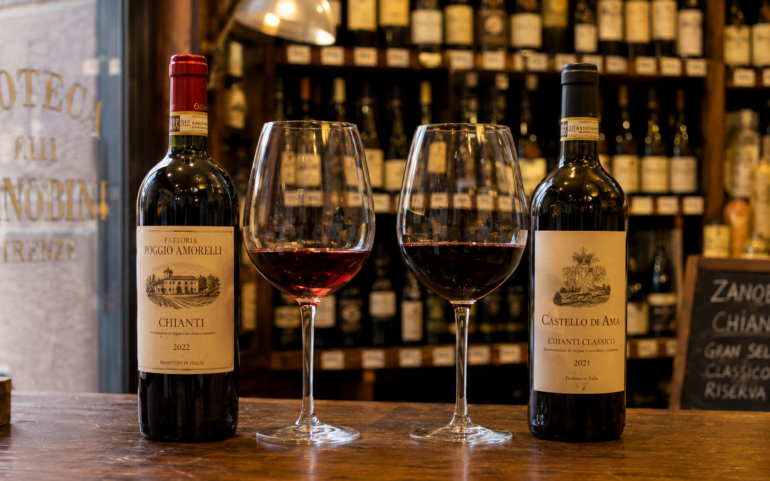
Why can two Chianti wines taste so different?
The difference between Chianti wines can surprise even people who already know and enjoy Tuscan wine. Many wine lovers expect Chianti to always offer the same profile: bright fruit, good freshness, lively acidity, and that recognizable Tuscan identity. Yet, as soon as you compare two bottles side by side, you often discover major differences in colour, aroma, texture, and finish. That is exactly what makes wine so fascinating: behind the same name there can be very different interpretations.
Understanding these differences does not mean making wine complicated. On the contrary, it helps you enjoy it with more awareness. For anyone who wants to experience wine in a more authentic way, wine tasting in Florence is also an opportunity to compare styles, discover nuances, and understand what really changes from one bottle to another.
Sangiovese is essential, but it is not the whole story
When people think of Chianti, they naturally think of Sangiovese. It is the grape that gives the wine much of its identity: freshness, structure, red fruit character, and that vibrant Tuscan personality. But even when two wines are based on the same grape, they are not destined to taste the same.
Sangiovese is extremely sensitive to its surroundings. It reacts strongly to climate, altitude, soil composition, and the choices made in the cellar. This is one of the main reasons the difference between Chianti wines can be so striking. One bottle may feel lighter and more immediate, while another may be deeper, more structured, or more complex.
Territory has a real impact on the glass
One of the most important factors is the territory. The slope of the vineyard, exposure to the sun, altitude, drainage, and the nature of the soil all influence how the grapes ripen. Even small changes in these elements can affect acidity, ripeness, aromatic intensity, and tannin structure.
This is why wine is so deeply connected to place. A bottle does not simply come from Tuscany in a generic sense. It comes from a specific part of Tuscany, shaped by a very precise environment. That is also why learning more about Chianti Classico helps wine lovers understand that the name on the label is only the starting point.
Vintage matters more than many people think
Even the same producer can release wines that feel quite different from year to year. Vintage is one of the strongest reasons for that. A warmer year can produce a wine that feels richer, rounder, and more generous. A cooler or more balanced year may preserve sharper acidity, more tension, and a fresher profile.
This means that a favourite bottle should never be seen as something fixed forever. Part of the pleasure of wine is returning to it over time and seeing how each vintage tells the same story in a slightly different way.
Ageing in steel, wood, or bottle changes the final style
The vineyard is only one part of the story. What happens after harvest is equally important. A Chianti aged mainly in stainless steel often keeps a more direct fruit character, a brighter freshness, and a more immediate style. A wine that spends time in wood may gain greater complexity, spice, structure, and a broader texture. Bottle ageing then adds another layer, allowing the wine to settle, evolve, and become more harmonious.
None of these choices is automatically better than the others. They simply lead to different expressions. This is another reason the difference between Chianti wines becomes so clear when tasting carefully: each ageing decision leaves a visible mark on the final result.
Tannins and acidity shape the experience
Two elements are especially useful when comparing Chianti: tannins and acidity. Tannins create that drying sensation you feel on the gums and tongue, while acidity gives the wine energy, freshness, and length. Some bottles show firmer and more youthful tannins, while others feel smoother and more integrated. The same applies to acidity, which can be more vivid or more rounded depending on the wine.
These elements never work in isolation. They interact with fruit, alcohol, ageing, and serving temperature. That is why tasting with attention reveals so much. What at first seems like “just another Chianti” can suddenly show a very different balance and personality.
Serving temperature also changes perception
A wine served too warm can feel heavier, less precise, and more alcoholic. A wine served too cold may seem closed, less expressive, and less generous on the nose. Chianti is no exception. The correct temperature helps the wine show its best balance between freshness, fruit, tannins, and aromatic detail.
Sometimes, when two people have very different opinions about the same bottle, the explanation is not mysterious at all. It may simply be a matter of temperature, glassware, or how long the wine had time to breathe.
Why tasting in a real enoteca makes things clearer
Wine becomes easier to understand when it is compared in the right setting. This is one of the reasons a historic enoteca can be so valuable. It is not only a place to buy a bottle, but also a place where wine can be explained, suggested, and experienced with greater clarity. In a real wine shop, context matters: atmosphere, conversation, and careful recommendations all help make the tasting more meaningful.
At Enoteca F.lli Zanobini, this way of approaching wine is part of the experience itself. Comparing different bottles, styles, and expressions of Tuscany helps people discover not only what they like, but also why they like it.
One name, many interpretations
In the end, that is what makes Chianti so interesting. It is not a single rigid style, but a family of interpretations. There is a common identity, of course, but within that identity there is room for many voices, many landscapes, and many choices.
Understanding the difference between Chianti wines does not take away the pleasure of drinking them. It does the opposite. It makes each glass more interesting, because it reminds us that wine is not just a product. It is the result of place, season, time, and human decisions, all coming together in one bottle.