
Vinattieri Florence
Vinattieri Florence: two words that seem to come from a distant time, made of small shops, chalices, markets, narrow streets and painted signs on old walls. Yet, walking through the San Lorenzo area, near Via Sant’Antonino, that history does not feel so far away.
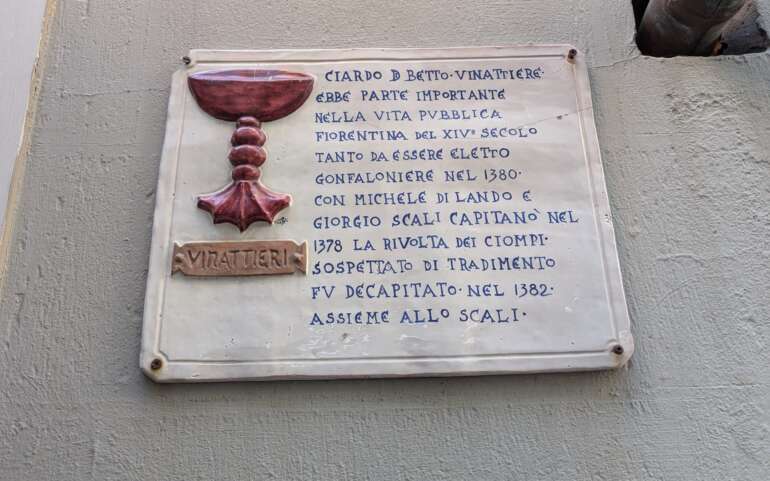
A ceramic plaque recalls Ciardo di Betto, vinattiere, a figure connected to fourteenth-century Florence. Beside the inscription, the red chalice recalls the ancient Arte dei Vinattieri, the guild that brought together those who lived by selling and serving wine in medieval Florence.
For those who enter Enoteca Zanobini today, a historic Florentine wine shop since 1944, that plaque is not simply a curiosity to notice while passing by. It is a small sign of continuity: wine as a trade, a story, a meeting point and a memory of the city.
Vinattieri Florence: wine in the medieval city
In medieval Florence, wine was not just a drink. It was part of everyday life, trade, social relations and the culture of the city. The shops of the vinattieri were places of passage, conversation and exchange, frequented by artisans, merchants, travellers and local residents.
The vinattieri sold wine, served it, stored it and talked about it. In a city organised through guilds and corporations, wine also had its recognised place. The Arte dei Vinattieri was one of the Florentine Minor Guilds and had a simple but powerful symbol: a red chalice on a white background.
That chalice, still visible today on historic plaques dedicated to the vinattieri, feels almost like a signature left by ancient Florence. It does not represent wine alone, but an entire world of trades, shops, cellars, measures, agreements and human relationships.
Ciardo di Betto, the vinattiere remembered by the plaque
The plaque tells the story of Ciardo di Betto, described as a vinattiere and remembered for his role in the public life of fourteenth-century Florence.
According to the memory preserved in this part of the city, Ciardo played an important role in Florence during the fourteenth century and was elected gonfaloniere in 1380. His name is connected with those of Michele di Lando and Giorgio Scali, figures linked to the turbulent period of the Ciompi Revolt.
The Ciompi Revolt of 1378 was one of the most intense episodes in medieval Florence. The uprising involved mainly the humblest workers of the wool industry, who demanded greater political recognition and representation. In a Florence marked by social tension and struggles for power, even a wine seller could find himself at the centre of civic life.
Ciardo’s story, however, had a tragic ending. The plaque recalls that, suspected of betrayal, he was beheaded in 1382 together with Giorgio Scali. It is a severe story, almost like a medieval chronicle, showing how closely trade, social life and politics were intertwined in Florence at the time.
To better understand the link between Ciardo and this area of the city, it is also interesting to read the historical reconstruction dedicated to the Cella di Ciardo, an ancient reference connected to the area between Via Sant’Antonino and Via dell’Ariento.
The Canto della Cella di Ciardo
The area around San Lorenzo still preserves many traces of mercantile Florence. Via Sant’Antonino, Via dell’Ariento, the Mercato Centrale and the nearby streets are places where trade, craftsmanship, food, wine and popular life have met for centuries.
Among the old names remembered in this part of the city is the Cella di Ciardo, probably linked to an ancient tavern or wine cellar. The Municipality of Florence, in its historical record for Via Sant’Antonino, also recalls this reference among the previous names associated with the street.
It is a valuable detail because it connects the story of the plaque not to a generic legend, but to a precise place in the city. Here, wine was not a decorative element: it was part of the urban landscape, daily habits and the identity of the neighbourhood.
The red chalice of the vinattieri
Perhaps the most fascinating symbol in this story is the red chalice. It appears on the plaque: essential, strong and immediately recognisable. It recalls wine, but also the social role of the vinattiere.
In the Middle Ages, signs were fundamental. Not everyone could read, but everyone could recognise a symbol. The chalice indicated the trade, the shop, the place where wine was sold and served.
Today, that same sign has a different value, more poetic and historical. It tells of a Florence made of recognisable trades, lively streets and shops open to the city. A Florence where wine passed from the countryside to the city walls, from cellars to counters, from flasks to chalices.
From vinattieri to a historic wine shop
Many centuries separate Ciardo di Betto from Enoteca Zanobini. It would be wrong to confuse the two periods. And yet there is an ideal thread that makes this story naturally close to the identity of the wine shop.
The medieval vinattiere was not just a seller. He was a neighbourhood figure, a person who knew wine, a meeting point. His shop was a place where people entered to drink, buy, talk, ask for advice and learn something about what came from the countryside and the hills.
In a different and contemporary form, a historic wine shop in Florence still preserves this function. It does not simply sell bottles: it welcomes, advises, tells stories, selects and connects wine with its territory.
At Zanobini, this continuity can be felt above all in the direct relationship with those who enter. Wine is not presented as an anonymous product, but as part of a story made of families, hills, grape varieties, vintages, traditions and personal choices.
San Lorenzo, wine and Florentine memory
San Lorenzo is one of the liveliest areas of Florence. The Mercato Centrale, the shops and the streets frequented by Florentines and travellers still create a commercial and popular atmosphere that recalls, at least in part, the ancient city.
In this context, the history of the vinattieri becomes particularly meaningful. It is not an isolated memory, but a story perfectly rooted in the neighbourhood. The plaques remind us that wine was part of city life long before Florence became an international travel destination.
For this reason, this article is not only about a plaque. It is about an identity. It is about a city where wine accompanied public life, work, trade and encounters between people.
Zanobini and wine as storytelling
Today, those looking for wine in Florence often want more than just a bottle. They are looking for an authentic place, a curated selection, expert advice and perhaps a glass to enjoy calmly in the centre of the city.
This is where the history of the vinattieri naturally speaks to Enoteca Zanobini. The medieval past is not turned into scenery, but becomes a discreet reminder: wine as a serious craft, as everyday culture, as a relationship.
Alongside its selection of Tuscan and Italian wines, the wine shop also tells the story of the Zanobini family’s bond with Tenuta Le Lame, in the heart of the Chianti Classico area. Wines such as Sorripa, Masso della Strega, Chianti Le Lame and Formazione bring another part of Tuscany into the glass: the hills, the vineyards and family production.
In this way, the story ideally returns to where it began: from the red chalice of the vinattieri to the chalice of today. The centuries change, the streets change, the ways of drinking and buying wine change. But the underlying idea remains the same: wine as a Florentine experience, to be lived and told.
A small plaque, a great story
The plaques dedicated to the vinattieri are not simply decorative details on the walls of Florence. They are signs of memory. They remind us that behind every trade there was a city, behind every symbol a guild, behind every chalice a story.
The figure of Ciardo di Betto gives the word “vinattiere” all its medieval strength: not only a man of wine, but a person placed at the heart of the political and social life of fourteenth-century Florence.
Looking at that plaque today, just a short walk from Enoteca Zanobini, means reading Florence with different eyes. It means understanding that wine here has never been just a drink. It has been trade, culture, encounter, memory and identity.
And this is precisely the heritage that a true Florentine wine shop can still preserve: not by copying the past, but by continuing to give value to wine as a living story of the city.